


Recent Performance
The balance of supply and demand in the Canadian housing market has shifted significantly since the post-pandemic price boom. The number of prospective buyers has dwindled as waves of new supply have entered the market. Accordingly, the RPS Canada 13-metro area weighted median house price reached about $865,000 in May, down 3.5% year on year and around 7.5% from its 2022 peak. The national median, at approximately $768,000, has softened further, declining 4% year on year and sitting about 9% below its April 2022 peak. By contrast, the 13-area weighted index declined a more modest 2.2% year on year. It remains about 4.3% below its peak, indicating that part of the weakness in median prices reflects changes in the composition of sales rather than a broad-based decline in underlying home values.
Regional trends continue to diverge. The largest and least affordable markets, Toronto and Vancouver, have experienced the most pronounced corrections, with year-on-year price declines of around 5% to 9% in May. These metro areas are particularly sensitive to interest rate changes because their elevated prices require more leverage. By contrast, Québec has been more resilient. Montréal continues to post solid annual gains in the mid- to high single digits, while growth is even stronger in smaller metro areas such as Québec City (see Chart 1).
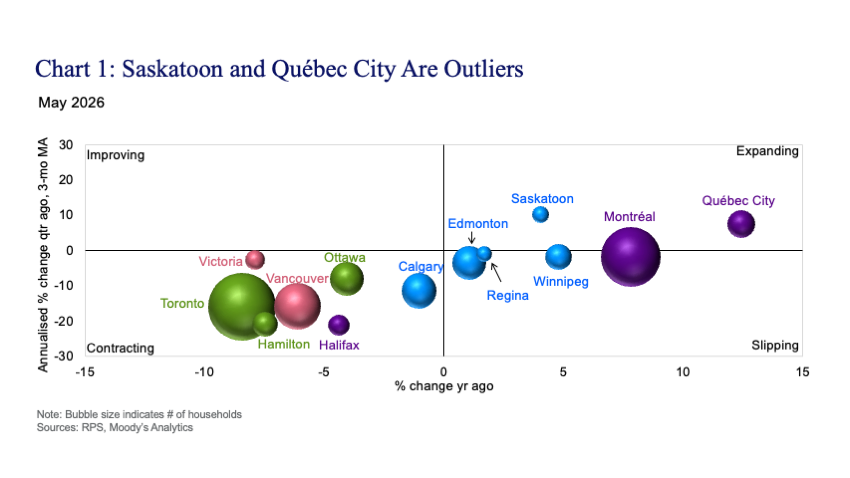
Prairie markets present a more nuanced picture. Although prices rose 1% year on year in Edmonton, they declined by a modest 1.3% in Calgary. However, recent readings point to a turnaround, with a month-on-month increase in Calgary. This outperformance reflects the Prairie markets’ relatively more moderate valuations and better affordability compared with coastal markets. Meanwhile, price growth in Atlantic Canada—including Halifax—continues to moderate following the outsize gains in previous years. Overall, the 13-area index highlights an uneven adjustment, with weakness concentrated in higher priced markets and resilience in more affordable regions.
Tentative signs that demand is stabilising are emerging. Nationally, resales rose for two
consecutive months—up 0.7% in April, followed by a stronger 5.5% jump in May, marking the strongest monthly increase in more than a year. Even so, resales remain about 5% below year-ago levels and pre-pandemic averages. New listings pulled back in May after the spring influx, tightening the sales-to-new-listings ratio to 49.2%—skewing towards the bottom of the balanced range of 45% to 65%. The number of months supply of inventory also declined to 4.8 nationally, close to the long-term average of five months. This is consistent with the typical pattern of housing market recoveries, in which transaction volumes stabilize and rise before sellers regain sufficient pricing power to arrest price declines. With the sales-to-new-listings ratio still below its long-run average and the 13-area index still falling modestly on a monthly basis, the market appears to be in transition—past the trough in activity, but not yet at the trough in prices.
New Supply Keeps Coming
The increase in prices over the past several years continues to support an above-average pace of new construction. According to the Canada Mortgage & Housing Corp.’s Spring 2026 Housing Supply Report, national housing starts in 2025 rose 6% year on year to 259,000 units.
The increase was broad-based, with apartment construction driving much of the national gain. Montréal led with 25,223 apartment starts, followed by Vancouver at 21,844 (see Chart 2). Of the seven largest census metro areas—Vancouver, Calgary, Edmonton, Montréal, Ottawa-Gatineau, Toronto, and Halifax—six recorded apartment-start levels above their 10-year averages. Toronto was the exception, posting a relatively healthy increase of 18,986 apartment starts but falling short of its 10-year average.
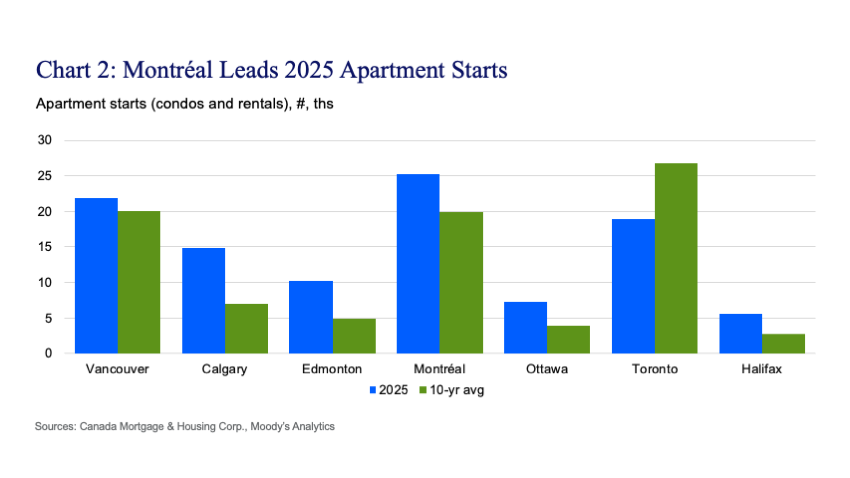
Regarding ground-oriented housing (single-detached, semi-detached, and row homes), Calgary and Edmonton posted the strongest results, with both metro areas exceeding their 10-year averages, making Alberta a standout province in the segment. Conversely, Toronto, Montréal, Ottawa-Gatineau, and Vancouver all saw their ground-oriented starts fall below their 10-year averages in 2025.
Across the seven largest CMAs, all markets except Edmonton recorded more apartment starts than ground-oriented starts in 2025. Apartment starts were well above their combined 10-year average, while ground-oriented starts were roughly in line overall, though slightly below trend. The composition of starts also shifted in key markets. On a 10-year average basis, Calgary and Ottawa-Gatineau leaned more heavily towards ground-oriented construction, but both shifted to apartment-led activity in 2025. Edmonton remained the only major market where ground-oriented starts still exceeded apartment starts, though the gap was much narrower than its 10-year average.
Overall, the data point to a continued shift towards higher-density housing, as rental construction accounted for the lion’s share of new supply. According to CMHC, rental starts reached record highs in Calgary, Edmonton, Ottawa-Gatineau, Halifax, and Montréal, while Toronto posted its second-highest level on record. By contrast, starts for single-detached, semi-detached, and row homes weakened, with the sharpest declines in Ottawa-Gatineau and Toronto.
The pace of homebuilding in 2025 was encouraging, but Canada still faces a housing shortage, keeping upward pressure on prices and prolonging the affordability crisis. Housing construction has not kept pace with population growth over the past decade. Problematically, as prices slip, builders are turning more cautious. At the current rate, housing starts this year will likely only match their 2025 level.
For context, in June 2025, CMHC estimated that Canada needs to build approximately 430,000 to 480,000 homes per year over the next decade to close the supply gap and restore affordability to pre-pandemic norms. But that figure is tracking closer to 250,000 in 2026. Moreover, rentals have carried supply growth, limiting the gains in homeownership.
Borrowers Feel the Pressure
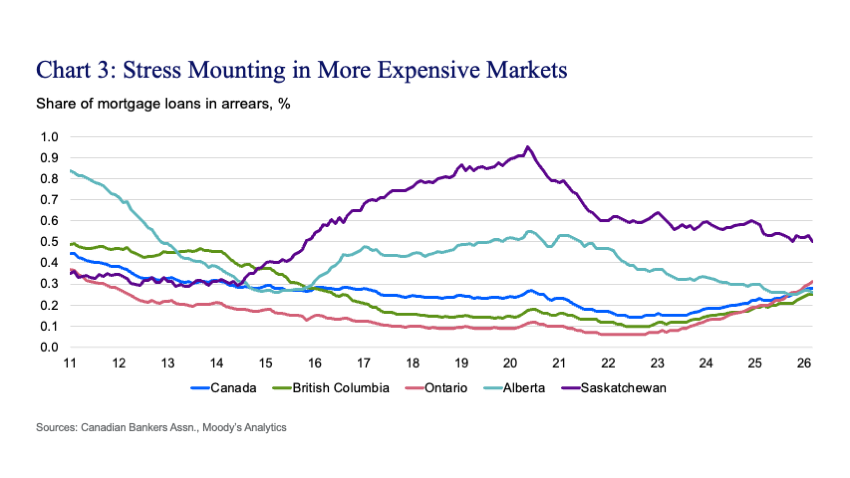
Elevated joblessness and record-high indebtedness have made it increasingly difficult for many borrowers to make their mortgage payments on time, especially as their interest rates reset from pandemic-era lows. The national mortgage delinquency rate rose to 0.28% in March, its highest point since early 2017 (see Chart 3). Serious delinquencies—those more than 120 days past due—have reached a 15-year peak, driving this climb. However, on a positive note, the number of less serious delinquencies remains steady, likely limiting future increases in defaults.
Regional trends diverge considerably, as weakness is concentrated in more expensive markets. Ontario’s delinquency rate has risen to a 15-year high of 0.31%, and British Columbia’s rate has hit a decade-high of 0.25%. Rates in the largest markets in these provinces—Toronto, Ottawa-Gatineau, and Vancouver—have mirrored the upward climb. Historically high joblessness in both provinces has put pressure on household finances.
Delinquency rates in most other provinces have increased more modestly. Québec’s rate has risen to 0.2%, which is still low by historical norms, while rates in Montréal and Québec City have moderated in recent quarters. Conversely, rates in Alberta and Saskatchewan have slipped to 0.41% and 0.5%, respectively, as all major metro areas have fallen to decade lows. Smaller mortgages, on average, and more stable employment have reduced financial stress for these households.
Rising mortgage payments and sluggish house prices will leave some borrowers with low or negative equity. If these borrowers are unable to make their payments, they will be ineligible for many refinancing options. Although the Bank of Canada expects just 4% of mortgage holders nationally to fall into this group next year, the effect will be more pronounced in vulnerable markets, such as Toronto, where this share will be upwards of 10%.
Outlook
Canada’s economy is stuck in neutral. The country should avoid a recession, but growth will be slow to gain momentum in the second half of 2026, leaving the housing market under continued pressure from soft income growth and restrictive lending conditions.
The debate over whether Canada has entered a technical recession is premature. More aptly, the economy has stalled rather than contracted. Weak hiring, softer consumption, and declining investment have constrained GDP growth, leaving the labour market in a low-hire, low-fire equilibrium. Employment has flatlined, but layoffs remain contained, keeping the unemployment rate elevated yet stable. Income growth is slowing but not collapsing. Wage gains are still relatively firm, but reduced hiring and fewer hours worked are tempering overall labour income and, therefore, weakening housing demand.
Assuming that a successful renewal of the United States-Mexico-Canada Agreement helps stabilize business investment and kick-start hiring, labour market conditions should gradually improve over the next 12 months, but only modestly. The rebound in employment is likely to be incremental, meaning income growth will be restrained for much of the year. For housing, this implies demand will remain soft in the near term but will slowly strengthen over time.
Although income dynamics will start to become more favourable, lending conditions remain a constraint. Interest rates are expected to remain elevated as the Bank of Canada balances above-target headline inflation against weak domestic growth. At the same time, higher-for-longer U.S. rates are feeding into global bond yields, tightening financial conditions in Canada. Thus, mortgage rates are likely to stay high, reducing the purchasing power of prospective buyers. The pass-through of earlier rate increases is still unfolding. As mortgages reset from ultra-low pandemic-era rates, debt-servicing costs are rising sharply, compressing household cash flow and weighing down consumption and housing demand.
Credit conditions are also tightening at the margin. Rising mortgage delinquencies—particularly among more vulnerable borrowers—are likely to keep lenders cautious. While systemic risks remain contained, banks are expected to maintain a conservative posture, potentially tightening underwriting standards and further limiting credit access for riskier borrowers.
Taken together, these forces point to a housing market that will stay under pressure through 2026. Weak income growth and no interest rate relief will keep sales in check and push down prices (see Chart 4).
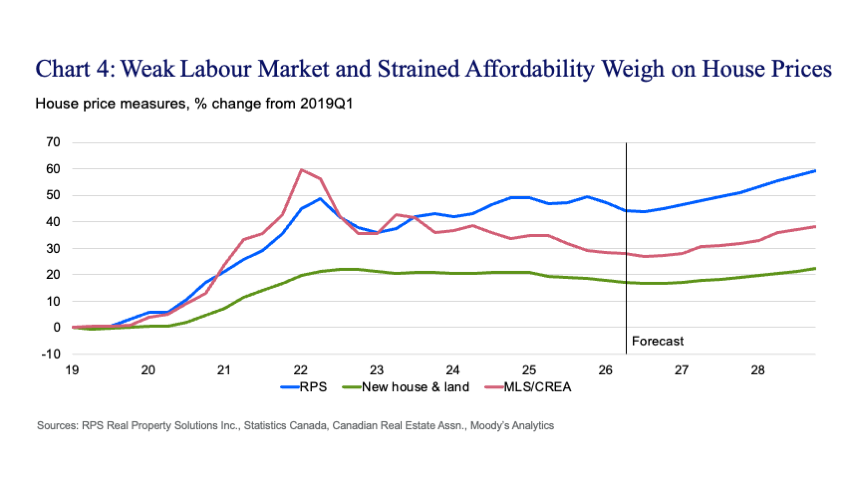
Regionally, the markets that have corrected most sharply—Ottawa-Gatineau, Halifax, and Hamilton—are expected to stabilize first. Toronto and Edmonton are likely to see the most delayed recoveries, weighed down by supply overhangs and persistent affordability constraints. Québec City and Montréal, which have led recent price growth, are forecast to decelerate as their affordability advantage narrows.
A sustained recovery will not take hold until labour market conditions improve more meaningfully and lending constraints ease somewhat. Both appear more likely to happen beyond the next four quarters than within them.
Risks
The foremost risk to the Canadian housing market is a major deterioration in trade relations with the U.S. If USMCA negotiations falter and tariffs intensify, the resulting hit to exports, business investment, and employment would likely tip the Canadian economy into recession. A trade-driven downturn would quickly undermine household income growth, erode confidence, and sharply weaken housing demand.
The second key risk is a further decline in the labour market. If weak hiring gives way to rising layoffs, unemployment would increase materially and push mortgage delinquencies higher. Lenders would likely respond by tightening credit standards further, amplifying the housing downturn. The resulting feedback loop between job losses, credit tightening, and falling house prices could trigger a broader housing correction and deepen any recession.
About Moody’s Analytics
In an increasingly interconnected and complex operating environment, organizations face challenges decoding the intricacies of the global economy. Moody’s Analytics Economics team delivers timely and in-depth data, forecasts and analysis of the global economy’s latest developments and trends—empowering organizations and policymakers to identify and manage risks, seize new growth opportunities, respond to geopolitical threats, and thrive in an ever-evolving landscape.
The Economics team has more than 35 years of dedicated experience in economic forecasting and research. Leveraging our team’s global coverage and local expertise, our economists provide unrivalled insight on pivotal economic topics, including labor markets, housing, commercial real estate, and consumer spending, among others, across the Americas, Europe, the Middle East, and APAC. We also provide real-time monitoring of economic indicators, scenario analysis, and thought leadership on critical themes such as monetary and fiscal policy and sovereign risk—all of which support decision makers and policymakers in strategic planning, product and sales forecasting, stress testing, credit risk management, and investment decisions.
By combining economic modeling, expansive data resources, and innovative technology solutions, we equip business leaders with critical insights to navigate the complexities of an ever-changing economic landscape. Recognized for our industry-leading solutions and commitment to quality, client service, and integrity, more than 1,000 organizations worldwide—including multinational corporations, governments, financial institutions, real estate fi rms, and professional investors—trust us to help them turn today’s risks into tomorrow’s opportunities.
Learn how Moody’s Analytics can help drive your success at www.economy.com.

Brendan LaCerda
Director of Economic, Moody’s Analytics
Brendan serves as the lead analyst for the Canadian economic forecast. His primary responsibilities also include the development and improvement of country forecast models. His research is primarily focused on international macroeconomics, healthcare and fiscal policy. Before joining Moody’s Analytics, Brendan worked as a senior economist with IHS Global Insight’s U.S. Macroeconomic Service. Brendan received his PhD in economics from the University of Virginia. He pursued his undergraduate education at the London School of Economics and the University of Notre Dame, where he graduated with a BA in economics and mathematics.
Brendan serves as the lead analyst for the Canadian economic forecast. His primary responsibilities also include the development and improvement of country forecast models. His research is primarily focused on international macroeconomics, healthcare and fiscal policy. Before joining Moody’s Analytics, Brendan worked as a senior economist with IHS Global Insight’s U.S. Macroeconomic Service. Brendan received his PhD in economics from the University of Virginia. He pursued his undergraduate education at the London School of Economics and the University of Notre Dame, where he graduated with a BA in economics and mathematics.

Abhilasha Singh
Associate Director & Senior Economist, Moody’s Analytics
Abhilasha specializes in macroeconomic modeling, forecasting, and economic analysis. As part of the model development and maintenance team, her work spans the global forecasting framework, where she contributes to the global macro model and leads the global subnational model. She also manages the Canadian house price model, overseeing model development, forecasting, and quality control of Canada’s subnational house price forecasts and broader subnational house price projections.
In addition to her modeling responsibilities, Abhilasha produces U.S. macroeconomic forecasts for client-driven, custom, and regulatory scenarios and translates baseline and alternative-scenario results into clear, decision-ready insights. She also produces forecasts and analysis for the Prairie provinces and their major metropolitan areas.
Abhilasha frequently presents on the U.S. economic outlook and engages with stakeholders across research, product, and sales teams. She holds a PhD in economics from the University of Houston and a master’s degree in finance from Pune University.
Abhilasha specializes in macroeconomic modeling, forecasting, and economic analysis. As part of the model development and maintenance team, her work spans the global forecasting framework, where she contributes to the global macro model and leads the global subnational model. She also manages the Canadian house price model, overseeing model development, forecasting, and quality control of Canada’s subnational house price forecasts and broader subnational house price projections.
In addition to her modeling responsibilities, Abhilasha produces U.S. macroeconomic forecasts for client-driven, custom, and regulatory scenarios and translates baseline and alternative-scenario results into clear, decision-ready insights. She also produces forecasts and analysis for the Prairie provinces and their major metropolitan areas.
Abhilasha frequently presents on the U.S. economic outlook and engages with stakeholders across research, product, and sales teams. She holds a PhD in economics from the University of Houston and a master’s degree in finance from Pune University.

Sebastian Mintah
Associate Economist, Moody’s Analytics
Sebastian is on the model-building team, helps cover the economies of several African countries, and is involved with various other projects. Among his responsibilities are covering several other states and metro areas as well as contributing to Economic View. Sebastian received his bachelor’s degree from Swarthmore College, graduating with a double major in Mathematics and Economics.
Sebastian is on the model-building team, helps cover the economies of several African countries, and is involved with various other projects. Among his responsibilities are covering several other states and metro areas as well as contributing to Economic View. Sebastian received his bachelor’s degree from Swarthmore College, graduating with a double major in Mathematics and Economics.

Kyra Kendrick
Associate Economist, Moody’s Analytics
Kyra supports the efforts of the global model development team and covers the economies of Jordan, Rwanda, Sudan and South Sudan as well as several U.S. metro areas. She received her bachelor’s degree from Villanova University, majoring in economics and minoring in political science and Arab & Islamic studies.
Kyra supports the efforts of the global model development team and covers the economies of Jordan, Rwanda, Sudan and South Sudan as well as several U.S. metro areas. She received her bachelor’s degree from Villanova University, majoring in economics and minoring in political science and Arab & Islamic studies.