


Recent Performance
Canada’s housing market lost momentum in the third quarter. After tentative improvement earlier in the year, existing-home resales weakened again in September as higher borrowing costs, softer labour market conditions, and uncertainty surrounding Canada-U.S. trade relations kept buyers cautious. National resales fell 2.3% from August to September, interrupting the improvement that had emerged during the spring.
Regional resale trends diverged at the end of the quarter. Ontario and British Columbia led the weakness, with affordability remaining particularly strained. September resales fell 5.3% from August in Toronto and 6.2% in Vancouver, with Victoria recording an even steeper decline. Resales also slowed in Winnipeg, Regina, Saskatoon, and Edmonton, though most of these markets still favoured sellers. Atlantic Canada showed mixed results, with resales in Halifax and Newfoundland and Labrador improving since the spring.
Residential construction remained subdued in the third quarter, with housing starts nearly unchanged from the previous quarter but down about 9% from a year earlier. Regional trends diverged: Starts weakened considerably in Ontario but strengthened in Quebec, the Prairies, and British Columbia.
Unsold new-home inventory remained elevated in the third quarter. Completed but unabsorbed single-detached units were virtu-ally unchanged from the second quarter, while multifamily units increased. Meanwhile, fewer multifamily units were under construction. A large inventory of completions and a shrinking construction pipeline suggest builders will remain cautious as the market absorbs existing supply.
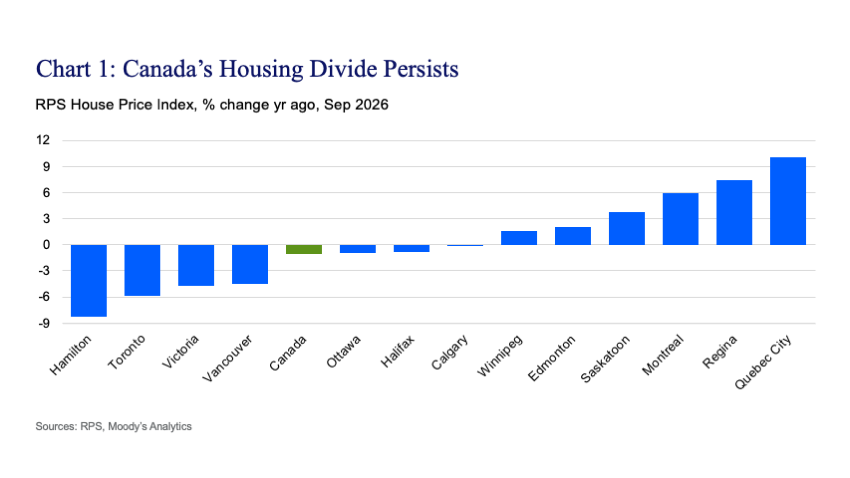
House prices reversed during the third quarter. According to the RPS House Price Index, modest national gains in July gave way to declines in August and September. Prices ended the quarter 1.1% below a year earlier, though the annual decline narrowed from June.
Regional price trends remained sharply divided (see Chart 1). Ontario and British Columbia continued to bear the largest corrections, led by Hamilton and Toronto, with Victoria and Vancouver also posting sizeable annual declines. Quebec and several Prairie markets remained stronger. Quebec City led the gains, with prices up about 10% from a year earlier, followed by Regina and Montreal. Edmonton recorded a more modest increase.
After easing from earlier peaks, mortgage rates have begun to rise again and are expected to remain high, limiting the recovery in housing demand. Elevated payments worsen already poor affordability, particularly in the costly Ontario and British Columbia markets. Quebec has proved more resilient, though affordability pressures are also beginning to weigh on markets that previously held up well.
Supply Shortfall Persists
Canada’s housing market remains under-supplied, despite temporarily soft demand. The Canada Mortgage and Housing Corp.’s Fall 2026 Housing Supply Report notes that the market is entering a more relaxed phase. Slower population growth and an uptick in housing completions across key cities have eased upward pressure on prices. However, a pullback in supply in response to temporarily weaker demand could lead to an overcorrection, causing demand to outstrip supply once the labour market improves. Nationally, according to CMHC’s estimates, Canada needs to break ground on around 440,000 housing starts annually through 2036 to restore pre-pandemic affordability. Currently, the market is barely exceeding half that goal.
That backdrop does not negate the strength seen in 2025, which built on the momentum in rental-led supply growth that had been developing since 2023 and has continued into 2026 (see Chart 2). CMHC’s Spring 2026 Housing Supply Report high-lighted that housing starts rose 6% to 259,000 units last year, driven largely by record rental construction and gains in missing-middle housing. But the composition of supply remains a key issue: Owner-ship-oriented construction has weakened, especially in the condominium segment, even as rental development has stayed comparatively resilient.
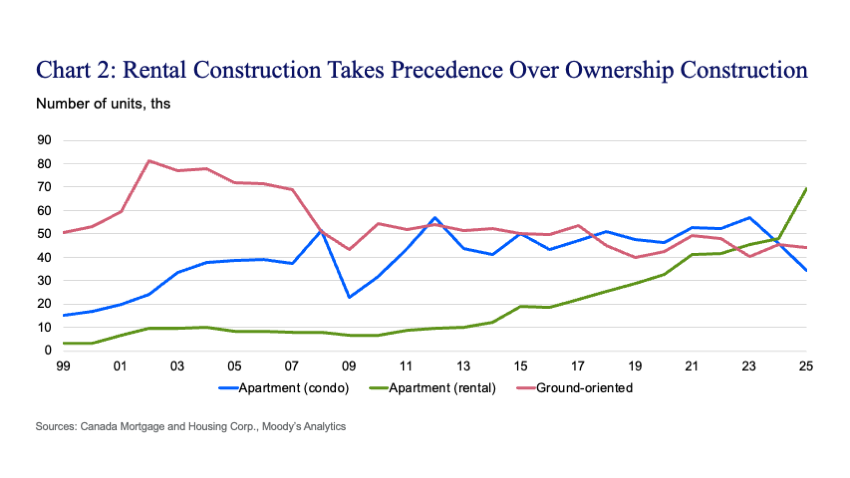
Across the major census metro areas covered by the supply report, rental apartment starts rose from 45,279 in 2023 to 47,929 in 2024 and then surged to 69,475 in 2025, while condominium apartment starts fell to 34,259, well below their 2023 peak. Population-adjusted starts in the first half of 2026 also show that Calgary and Edmonton remain the clear leaders, despite tallying fewer starts than a year earlier. Meanwhile, Montreal improved modestly to 30 starts per 10,000 people in 2026, up from 28 a year ago, but still trails Alberta’s markets.
Montreal remains a good example of the broader national dilemma. The fall report reveals that the metro area’s supply gap widened this year, even though starts, units un-der construction, and completions remain elevated. Further, rental units accounted for a record 86% of Montreal’s housing starts in the first half of 2026, while condo and ground-oriented ownership starts stayed near multiyear lows. Most supply growth is still coming through rentals, which helps near-term market balance, but much of this new rental supply falls into higher-rent categories. That means vacancy rates may rise at the upper end of the market as more units come on line, while vacancy rates for affordable rental units may remain low, exacerbating housing affordability concerns. Moreover, because so much of the new supply is concentrated in rentals, construction activity is doing less to address the ownership side of the affordability problem.
Overall, the metro-level starts data are mixed, but the broader data point to an in-sufficient pace of new construction. In CMHC’s September monthly housing starts release, total starts rose 3% to a seasonally adjusted annualised rate of 248,896 units. Yet, the national six-month trend remained well below the 440,000 annual pace that CMHC estimates is needed to close the supply gap by 2036 and restore pre-pandemic affordability.
BC’s Condo Buyout
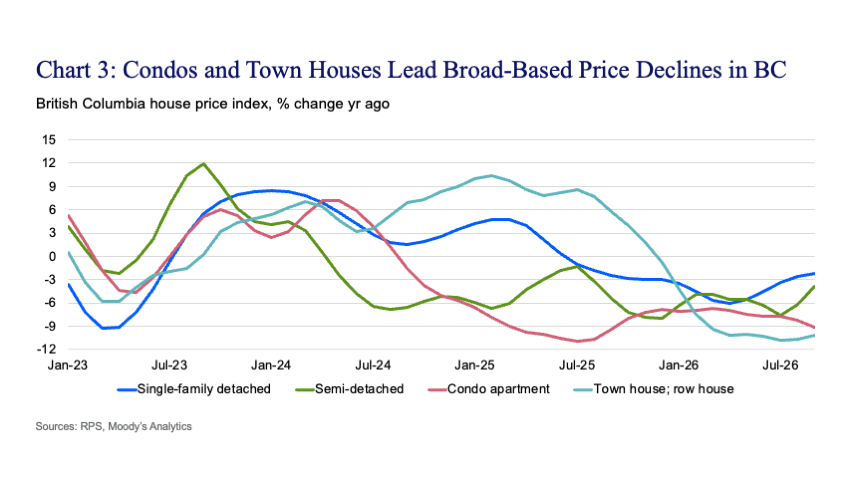
The condo market continues to cool, with prices falling 14% nationwide since peaking in 2022 (see Chart 3). In British Columbia, the federal and provincial governments plan to buy up unsold condos to address excess supply. Rising borrowing costs and worsening affordability have weighed on the condo market. The gap has widened between what buyers are willing to pay and what developers need to charge based on pre-construction dynamics. As a result, builders are struggling to sell units profitably, contributing to a large buildup in inventory.
The proposed intervention aims to alleviate some of this stress. The number of purchased condos would be capped at 2,200 at a total of C$1.45 billion. This represents a third to a half of the current unabsorbed inventory across BC’s four metro areas, which is at a record high. The buyout would bring inventories closer to historically average levels and help limit future price declines. The units would then be converted to rent-to-own housing, providing an alternative pathway to homeownership.
The condo buyout raises concerns about moral hazard. Even if the government buys properties at below-construction-cost prices and developers incur losses, the implicit insurance against extreme losses could encourage excessive risk-taking in the future.
Outlook
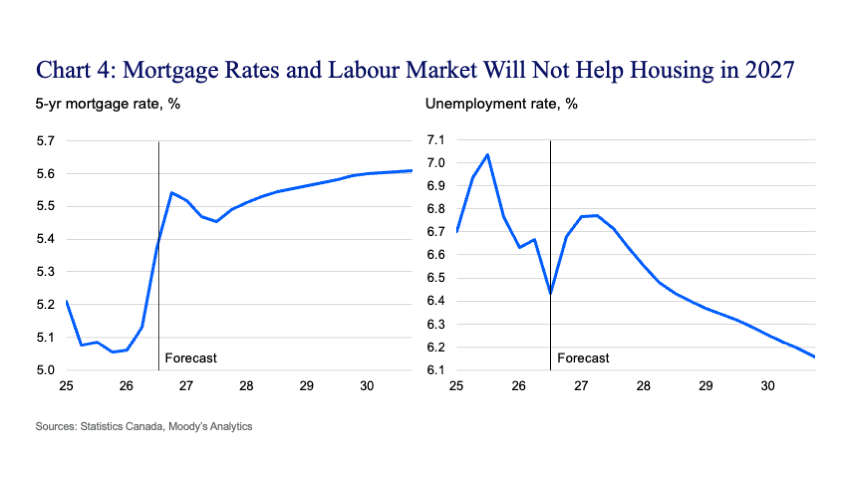
House prices are expected to steadily regain momentum in 2027 after their declines earlier in 2026, but the recovery will be slow and modest. A weaker labour market, higher inflation, and rising borrowing costs are limiting affordability, while a further slowdown in homebuilding is restraining new supply and helping to firm prices (see Chart 4). Therefore, the Moody’s Analytics baseline outlook for house prices has been revised lower over the past few months, though prices are still expected to rise over the next year.
The housing recovery will remain uneven across regions. Ontario and British Columbia will lag as strained affordability and subdued demand limit price gains, particularly in Toronto and Vancouver. Quebec and parts of the Prairies should fare better, though elevated borrowing costs will temper appreciation. The foreign-buyer ban, which is assumed to expire at the start of 2027, will also have differing regional effects, with greater implications for large metro areas than for rural areas, which are exempt from the federal prohibition. Even in major metro areas, however, the influence on prices should remain modest given foreign buyers’ historically small share of purchases. Domestic fundamentals will remain the primary drivers of the recovery.
Tariffs and soft consumer demand have put businesses into a more defensive posture. Employers have sharply limited hiring, but layoffs remain modest. Elevated energy prices add to the strain. With headline inflation outpacing wage growth, real incomes are shrinking, cutting into core consumer spending. The baseline assumes that tariffs remain in effect through 2028 and that the war in Iran keeps oil prices elevated.
Borrowing costs are poised to start rising. Strong demand for funds from governments and from corporations financing the artificial intelligence build-out is pushing yields higher, and mortgage rates are likely to follow. Weaker job security, lower real incomes, and costlier mortgages all reduce housing demand and slow the price recovery.
Builders are taking their cue. New construction will likely slow further in 2027, keeping the supply of new homes in line with softer demand. Less new supply is part of what helps prices pick up. Moody’s Analytics expects price gains to build gradually through 2027 as hiring slowly picks back up after a weak start to the year. With Canada avoiding recession, the Bank of Canada holds its policy rate steady through most of the year. The pace is slower than previously forecast due to the intensified tariff threat to the labour market and the drag on affordability from higher interest rates and inflation.
Risks
The biggest risk is that the labour market weakens much more than the baseline assumes. A drop in demand would turn prices south, and the pace of new construction would follow. The likeliest triggers are a pull-back in consumer spending following an AI-related stock market correction, or a more prolonged energy crisis that forces the Bank of Canada to respond to accelerating core inflation by raising interest rates.
The potential for higher prices is limited, but a larger-than-expected slowdown in new construction, combined with a favourable pivot in U.S. tariff policy, could cause demand to quickly outstrip supply and reenergise prices.
About Moody’s Analytics
In an increasingly interconnected and complex operating environment, organizations face challenges decoding the intricacies of the global economy. Moody’s Analytics Economics team delivers timely and in-depth data, forecasts and analysis of the global economy’s latest developments and trends—empowering organizations and policymakers to identify and manage risks, seize new growth opportunities, respond to geopolitical threats, and thrive in an ever-evolving landscape.
The Economics team has more than 35 years of dedicated experience in economic forecasting and research. Leveraging our team’s global coverage and local expertise, our economists provide unrivalled insight on pivotal economic topics, including labor markets, housing, commercial real estate, and consumer spending, among others, across the Americas, Europe, the Middle East, and APAC. We also provide real-time monitoring of economic indicators, scenario analysis, and thought leadership on critical themes such as monetary and fiscal policy and sovereign risk—all of which support decision makers and policymakers in strategic planning, product and sales forecasting, stress testing, credit risk management, and investment decisions.
By combining economic modeling, expansive data resources, and innovative technology solutions, we equip business leaders with critical insights to navigate the complexities of an ever-changing economic landscape. Recognized for our industry-leading solutions and commitment to quality, client service, and integrity, more than 1,000 organizations worldwide—including multinational corporations, governments, financial institutions, real estate fi rms, and professional investors—trust us to help them turn today’s risks into tomorrow’s opportunities.
Learn how Moody’s Analytics can help drive your success at www.economy.com.

Brendan LaCerda
Director of Economic, Moody’s Analytics
Brendan serves as the lead analyst for the Canadian economic forecast. His primary responsibilities also include the development and improvement of country forecast models. His research is primarily focused on international macroeconomics, healthcare and fiscal policy. Before joining Moody’s Analytics, Brendan worked as a senior economist with IHS Global Insight’s U.S. Macroeconomic Service. Brendan received his PhD in economics from the University of Virginia. He pursued his undergraduate education at the London School of Economics and the University of Notre Dame, where he graduated with a BA in economics and mathematics.
Brendan serves as the lead analyst for the Canadian economic forecast. His primary responsibilities also include the development and improvement of country forecast models. His research is primarily focused on international macroeconomics, healthcare and fiscal policy. Before joining Moody’s Analytics, Brendan worked as a senior economist with IHS Global Insight’s U.S. Macroeconomic Service. Brendan received his PhD in economics from the University of Virginia. He pursued his undergraduate education at the London School of Economics and the University of Notre Dame, where he graduated with a BA in economics and mathematics.

Abhilasha Singh
Associate Director & Senior Economist, Moody’s Analytics
Abhilasha specializes in macroeconomic modeling, forecasting, and economic analysis. As part of the model development and maintenance team, her work spans the global forecasting framework, where she contributes to the global macro model and leads the global subnational model. She also manages the Canadian house price model, overseeing model development, forecasting, and quality control of Canada’s subnational house price forecasts and broader subnational house price projections.
In addition to her modeling responsibilities, Abhilasha produces U.S. macroeconomic forecasts for client-driven, custom, and regulatory scenarios and translates baseline and alternative-scenario results into clear, decision-ready insights. She also produces forecasts and analysis for the Prairie provinces and their major metropolitan areas.
Abhilasha frequently presents on the U.S. economic outlook and engages with stakeholders across research, product, and sales teams. She holds a PhD in economics from the University of Houston and a master’s degree in finance from Pune University.
Abhilasha specializes in macroeconomic modeling, forecasting, and economic analysis. As part of the model development and maintenance team, her work spans the global forecasting framework, where she contributes to the global macro model and leads the global subnational model. She also manages the Canadian house price model, overseeing model development, forecasting, and quality control of Canada’s subnational house price forecasts and broader subnational house price projections.
In addition to her modeling responsibilities, Abhilasha produces U.S. macroeconomic forecasts for client-driven, custom, and regulatory scenarios and translates baseline and alternative-scenario results into clear, decision-ready insights. She also produces forecasts and analysis for the Prairie provinces and their major metropolitan areas.
Abhilasha frequently presents on the U.S. economic outlook and engages with stakeholders across research, product, and sales teams. She holds a PhD in economics from the University of Houston and a master’s degree in finance from Pune University.

Sebastian Mintah
Associate Economist, Moody’s Analytics
Sebastian is on the model-building team, helps cover the economies of several African countries, and is involved with various other projects. Among his responsibilities are covering several other states and metro areas as well as contributing to Economic View. Sebastian received his bachelor’s degree from Swarthmore College, graduating with a double major in Mathematics and Economics.
Sebastian is on the model-building team, helps cover the economies of several African countries, and is involved with various other projects. Among his responsibilities are covering several other states and metro areas as well as contributing to Economic View. Sebastian received his bachelor’s degree from Swarthmore College, graduating with a double major in Mathematics and Economics.

Kyra Kendrick
Associate Economist, Moody’s Analytics
Kyra supports the efforts of the global model development team and covers the economies of Jordan, Rwanda, Sudan and South Sudan as well as several U.S. metro areas. She received her bachelor’s degree from Villanova University, majoring in economics and minoring in political science and Arab & Islamic studies.
Kyra supports the efforts of the global model development team and covers the economies of Jordan, Rwanda, Sudan and South Sudan as well as several U.S. metro areas. She received her bachelor’s degree from Villanova University, majoring in economics and minoring in political science and Arab & Islamic studies.